
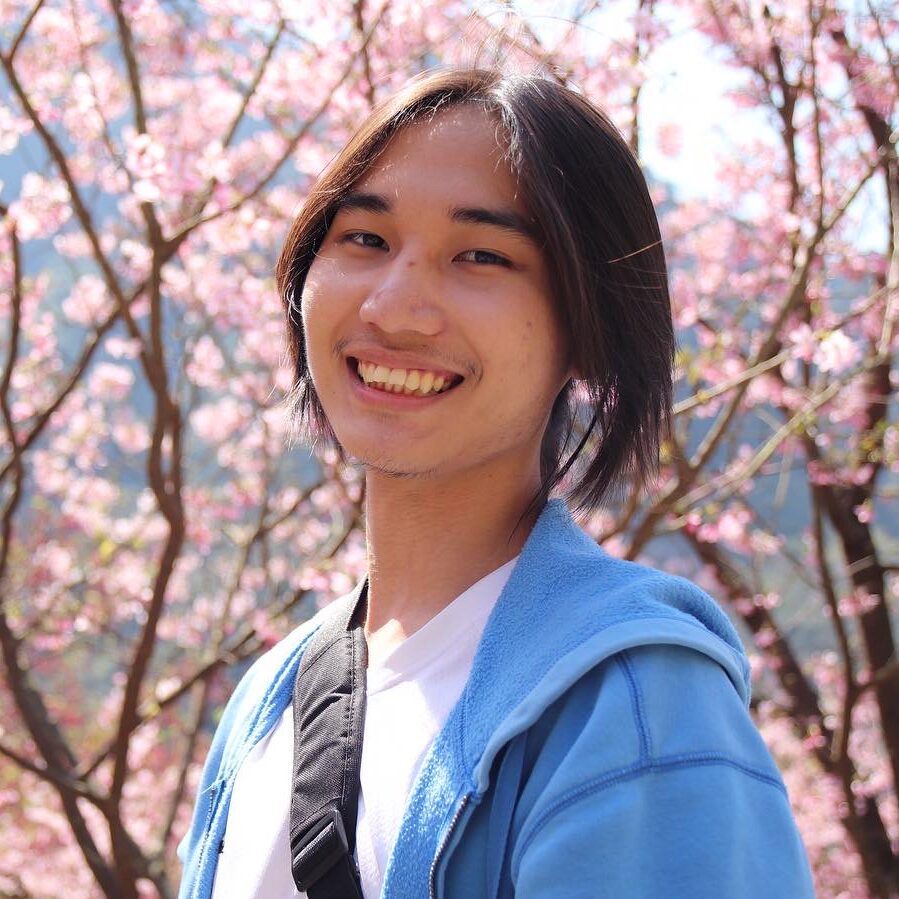
HELLO, MY NAME IS

I-LI CHIU

Superconducting Quantum RF Student

I am building a physics-centered data practice: learning superconducting quantum systems while developing the tools to generate, manage, analyze, and verify research data.

About Me

I am drawn to problems that begin as a rough physical question rather than a clean assignment. My habit is to slow the problem down, name the assumptions, and build a small loop that can be checked by code, simulation, or data.

The road I am building is not about becoming someone who only knows how to use tools. I want tools to become leverage for understanding physical questions; data generation, management, and analysis are ways to make research inspectable, reproducible, and extensible.

AI is part of that loop, but not a replacement for judgment. I use it to widen the search space, draft competing implementations, find blind spots, and accelerate documentation; the final answer still has to survive derivations, numerical checks, and direct inspection.

I care about quiet, reliable systems. A good script, storage setup, simulation report, or note should make the next question easier for future me and for the people working with me.

Selected Work

Floating-Qubit Energy Relaxation Study

Undergraduate thesis, National Central University

  • Model validation
  • Admittance formulation
  • Full-wave FEM
  • Framed the physical model: Applied an admittance-based formulation to describe floating-qubit coupling paths and make the energy-relaxation mechanism explicit enough for analytical and numerical review.
  • Cross-checked assumptions: Compared quasi-static extraction with full-wave finite-element simulation to identify where model assumptions stayed consistent and where numerical differences could arise.

Layout-to-FEM Research Workflow

Research data generation through simulation automation

  • AI-assisted tooling
  • Simulation automation
  • Parameter sweep
  • Built an iteration loop: Developed a data-generation workflow from GDSII layout to FEM simulation, connected to parametric design tooling so layout changes could become solver-ready experiments more quickly.
  • Used AI as engineering leverage: Worked in human-led, AI-assisted loops to draft automation paths, compare implementation options, review generated code, and keep the tooling tied to the underlying physics constraints.
  • Mapped circuit parameters: Linked lumped circuit models to Hamiltonian-level quantities around coupling strength and ZZ interaction space, enabling targeted scans for calibration-sensitive parameters.

Compute and Mesh-Refinement Operations

Simulation data analysis and verification

  • HPC operations
  • Mesh refinement
  • Numerical reliability
  • Ran larger solver workloads: Used National Center for High-performance Computing (NCHC) cluster resources to produce and inspect larger simulation datasets for complex layout FEM models.
  • Balanced time and accuracy: Tuned mesh-refinement parameters systematically so runtime, resource usage, numerical differences, and reliability could be evaluated with concrete evidence.

Research Infrastructure and Data Environment

Research data management and compute operations

  • NAS operations
  • Docker
  • Research systems
  • Supported lab data practices: Helped maintain a lab-scale Synology NAS environment, improving backup habits, team access, and day-to-day reliability for research data.
  • Built personal research infrastructure: Maintained a customized TrueNAS system integrated with Docker for research-data organization, automated backups, and flexible local compute environments.

Education

National Central University

B.S. in Physics · Expected 2026

  • Thesis: Study of XY-Line External Coupling Effects on Floating Qubit Energy Relaxation